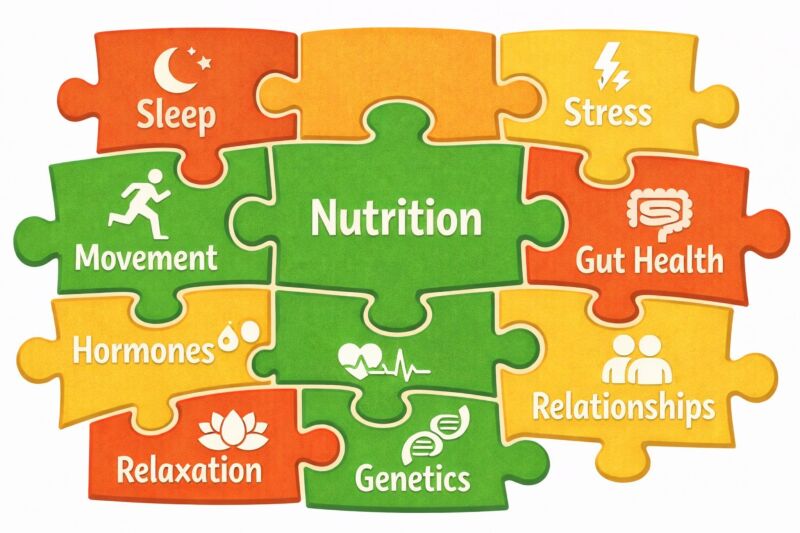
If you’re living with an ongoing health concern you’ve probably tried doing all the ‘right’ things – adjusting your diet, following medical advice, taking supplements – but you may still not feel as healthy as you’d like. Or, may be your symptoms keep changing making it hard to pinpoint what’s going on. This is not only frustrating, but can add to your problems.
Health isn’t shaped by any one factor — it’s the product of how multiple areas of your life interact. While nutrition is important, it’s just one piece of a much larger puzzle. Sleep, stress, physical activity, gut health, relaxation, and relationships all influence how your body and mind function. In clinical practice, it’s rarely one single factor that drives symptoms, but the interaction between the different factors.
I was trained as a Nutritional Therapist using the functional medicine approach which considers factors that contributed to your current health (antecedents), what triggered the health concern, factors that continue to contribute to your symptoms (mediators), and your daily lifestyle patterns. When we look at all these things together, we can identify what is within your control and where real change can begin to help you feel healthier. Just making a series of small changes can lead to noticeable improvements in how you feel.
Antecedents, Triggers and Mediators
Antecedents are factors that may have contributed to your current health status. The health of your family and potential genetic links is typically a factor here. While we can’t change your genetics, we may be able to influence the factors that affect how your genes are expressed through nutrition and lifestyle. There is a growing field of nutrition called nutrigenomics which focuses on nutrition and genetic links.
Triggers are the factors that are believed to have caused the health concern. For example, a stomach issue may have started following a holiday abroad.
Mediators are factors that may be contributing to the continuation of your symptoms. Medication is something that comes in here due to the potential for side effects, but as a Registered Nutritional Therapist this is something I cannot change. We can however consider factors such as your living environment, habits, work patterns, stressors and smoking.
Looking at all three of these areas means that we don’t just look at what’s happening now, but how your symptoms may have started and what is keeping them going. Understanding this can help identify where we can make realistic changes to help you feel healthier.
Symptoms and Systems
When you experience a variety of symptoms, they may not feel connected. But, your body works using interconnected systems, or functions, and symptoms are linked to more than one system. When I work with clients I look at all of their symptoms in terms of these systems to identify which systems may actually need the most support. And, it isn’t always the one you’d expect.
Below are the systems I consider, along with some of the typical symptoms that may be seen (you might recognise yourself in one of these):
- Upper digestion – Bloating, burping
- Lower digestion – Constipation
- Immunity – Sinus congestion, allergies
- Structural integrity – Joint pain, dermatitis
- Hormones – High stress, poor sleep, cycle changes, mood shifts
- Circulation – Fluid retention
- Energy – Poor sleep, irritability if meals are missed
- Mental, emotional and spiritual health – Grief, stress
Once the systems have been identified, nutrition and lifestyle factors that support them will be considered. The goal isn’t to suppress symptoms, but to identify which systems are under strain and provide targeted support.
You are the Finished Picture – Each System Provides a Piece of the Puzzle
We tend to think about our health in compartments – digestion, hormones, stress and joints – but the body doesn’t work in compartments.
Four of the most common lifestyle factors that can affect every compartment are sleep, stress, movement and nutrition. And, each of these can also affect each other. For example, sleep, stress and movement can affect many aspects of your health, as well as each other:
- Sleep: Poor sleep can affect our appetite and glucose regulating hormones, and contribute to you feeling stressed.
- Stress: Stress activates cortisol and other stress-related hormones, which can influence digestion, energy, cravings, and sleep.
- Movement: Regular activity supports cardiovascular health, digestion, sleep, and mood and stress.
From a nutrition viewpoint, each of these things affects how you digest food and absorb nutrients. They also impact appetite and weight management. Part of the link here is the influence of your gut health, which not only affects your digestion, it can also affect your general health. It is claimed that 70% of your immunity is in your gut – sleep, stress and movement all play a part in supporting it.
The Nutrition Piece
Each of the systems within your body needs resources in the form of energy and materials to function. Some of these are produced by other systems in the body, while some are provided by your diet. Your diet provides carbohydrate, protein and fat, as well as the often overlooked vitamins and minerals, fibre and more. The mineral magnesium, for example, is sourced from our food and is essential for hundreds of processes in the body, including sleep and energy, and we may need more of it when we are feeling highly stressed. Antioxidants (including some of the vitamins) help us to manage inflammation, our stress response and can support pancreatic health.
Hydration is important to support both body and brain as both are made up largely of water.
Many people try to eat a reasonably balanced diet so that they can feel healthy, but when stress is high and sleep is lacking, that may not be enough to support your body. When your life stage, circumstances, lifestyle and health change, your body’s requirements can change too, meaning you may need to tailor your diet more specifically.
The Gut Piece
The gut makes up your digestive system starting at your mouth, although typically it is a term used to refer to the intestines. The gut houses a microbiome which affects your general health, including hormone regulation, digestion and immunity. It can produce small amounts of nutrients too.
You can support your gut through sleep, stress management techniques, movement and a nutrient-rich diet. Fibre is important for moving food through your gut enabling nutrients to be absorbed and waste removed efficiently. Prebiotics and probiotic foods support the health of the microbiome. Studies suggest that heavily processed foods (UPFs) are detrimental to the gut and microbiome by reducing diversity and increasing inflammation. This may in turn affect the health of the brain through the gut-brain axis. Aim to source the majority of your diet from whole and minimally processed foods, to support your health.
The Relationships and Relaxation Pieces
As a Nutritional Therapist I also consider how relationships and relaxation practices may be contributing to a client’ wellbeing:
- Relationships – relationships can be a source of joy and stress, they can provide support or hinder us in achieving goals, they can promote or interfere with our habits and routines, they can influence our sleep and movement
- Relaxation practices – what you do to relax can affect how well you cope with stress, and how well you sleep
For some, relaxation practices aren’t always helpful and they may be linked to relationships that are thought to be positive – think nights out to recover from the stressful week, with alcohol and convenience foods.
- Positives: walking between venues, dancing at nightclubs, joy of human connections, time away from life’s stresses
- Negatives: reduced sleep, high alcohol consumption (liver health, gut health, blood sugars), less healthful food choices, potential application of health-risky habits such as smoking and recreational drugs that wouldn’t be used otherwise.
In some cases, the cumulative impact of these negatives may outweigh the positives, but focusing on keeping and building on the positive aspects of the scenario is important to supporting health. Even exercise can be a stress on the body, especially if high-intensity.
Often it isn’t about removing parts of your life, it’s about adjusting them so they better fit your health puzzle.
Fitting the Pieces Together
Just like when you are deciding which way around a jigsaw piece needs to go to complete the puzzle, small changes to your lifestyle and diet can make a difference to your health and wellbeing.
For some people big changes are needed and they are able to make those changes quickly (the ‘all or nothing’ types), while others need to break the changes down into smaller steps. It’s important that I work with clients as individuals if I’m not going to add extra stress and overwhelm to their puzzle pieces!
Approaching nutrition using a personalised, functional approach allows for more sustainable improvements to health and wellbeing. Understanding how the whole puzzle fits together helps to identify imbalances that could be affecting more than just what is currently seen on the surface.
References/Further Reading
The Detrimental Impact of Ultra-Processed Foods on the Human Gut Microbiome and Gut Barrier – Rondinella, et al (2025) – https://pmc.ncbi.nlm.nih.gov/articles/PMC11901572/