While some countries are changing their healthful eating guidance to incorporate sustainability, as a Nutritional Therapist, I think this muddles key messages and so try to keep the two topics separate. Both concepts are important, but they are not the same:
- Sustainability focuses on reducing environmental impact – food miles, chemicals, biodiversity.
- Healthful eating focuses on individual dietary needs – nutrient density, lifestyle, health status.
However, it is possible to be mindful of sustainability while making food choices that support your health. This article offers a few suggestions.
Reducing chemicals
The chemicals added to our food can, and often do, reach our plates. And, although legal restrictions are in place for the types and quantities of those chemicals, they are not necessarily good for us. Some are bioaccumulative (i.e. they build up in the body) and even at permitted levels, long-term exposure may pose risks.
Of course, buying organic is not feasible for many people and can result in a diet offering less variety of foods and nutrients. So, one option is to consider the foods you buy and the amount of chemicals that may be applied to them – can you swap those items? The Dirty Dozen list by Pesticide Action Network UK details the most likely contaminated fruit and vegetables available in the UK (to get the list you need to subscribe – free).
Grow your own
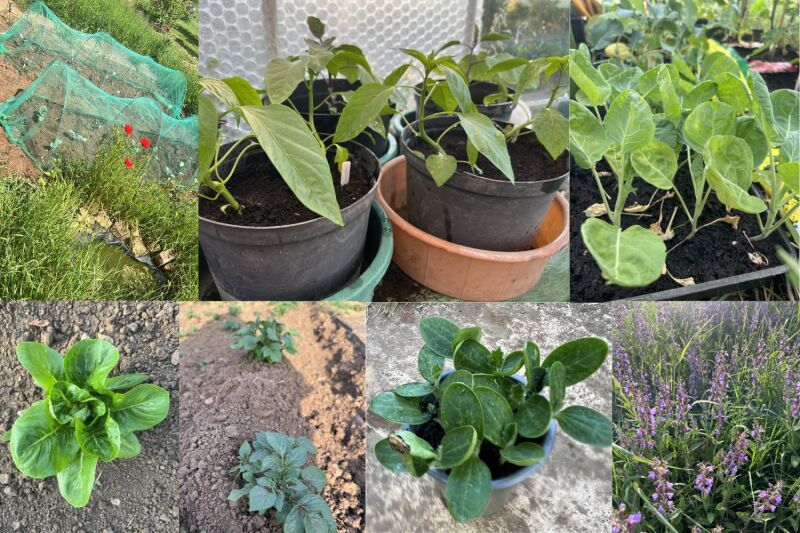
Another way of reducing your chemical intake is to grow your own food. This way you control what you apply to it. It also reduces food miles and reduces packaging. Gardening is also great for mental health – and growing your own food certainly helps develop resilience!
I rent an allotment which gives me lots of space to grow my own fruit and veggies (the photos above were taken on my plot this year) but if you don’t have access to a large area, or the time to manage it, you can grow some items in pots:
- Herbs can be grown in pots indoors or outdoors. I converted an old sand and water play table into a herb table at home. Some herbs such as mint are best kept in pots as they will take over any space you give them.
- Fruit trees. Patio varieties or many fruits are now available at garden centres or online. Alternatively, you could simply have a blackcurrant bush in a pot outside.
- Over the last few years potatoes in a bag became popular as a method of growing potatoes in a small space, and with less effort than growing them in the ground.
- Tomatoes can be grown in pots or growbags with some varieties suitable for outdoor growing. Cherry tomatoes can be grown in pots or hanging baskets, depending on the variety.
- Salad leaves. Spinach, chard, lettuce and other salad leaves are great grown in pots. Some varieties of lettuce grow small and are pick-and-grow-again so you don’t need as many plants to last the season.
- Unlike cucumbers, courgettes do well outside and they don’t trail. This means they can be easily contained in a large pot. Make sure you keep an eye on the growing fruit to pick them before they become marrows – it happens quickly once they start!
Other easy grows include spring onions and radishes.
Many allotment holders on our site also have egg-laying chickens and there have been ducks on there too! I haven’t gone down this route due to the level of commitment involved, but could that be an option for you?
When you take on a piece of land, if you want to grow organic, it is worth noting that the Soil Association state land needs to have been chemical-free for two years before it can be considered organic.
Buy local and seasonal
If you can’t grow your own food, think about the choices you are making when buying foods. How far has the food travelled? How long has it been stored?
Storing food reduces the nutritional content and so eating fruit and veg as soon as possible after harvesting is always best. This is where frozen fruit and veg can be great as they are frozen soon after picking and the nutrient content is protected – frozen items may contain as many, if not more, nutrients than the equivalent items from a store’s ‘fresh’ section.
Keep an eye out for local farmers markets or nearby farm shops where you can find fruit, veg, meat, dairy and eggs with low food miles and freshly harvested. Make sure you check the labels though as not everything will be from the farm the shop is located by.
If you choose foods from further away, check the labels to assess which varieties have the lowest food miles.
Of course, some foods grown locally could have high environmental costs. Tomatoes and cucumbers, for example, grown in greenhouses out of season are likely to incur big energy costs to create the correct light and temperatures for the plants to thrive.
Reduce processed food, including “plant-based”
Processed food, particularly ultra-processed food (UPF) is often marketed as healthful. While some claims may be accurate, much of this is often halo marketing – promoting a small benefit while ignoring the bigger negatives. There is mounting evidence that UPFs are detrimental to health.
We have been persuaded that a plant-based diet is better for the environment and our health – but this is a diet made of actual, whole plants, not the laboratory produced items we see on shop shelves. In terms of the environment, whole foods can also require fewer resources to produce and retain nutrients. A 2024 study by Rauber, et al found that plant-sourced UPF consumption was associated with a 5% increased risk of cardiovascular disease, and a 12% higher risk of cardiovascular-related mortality.
Food waste
The seemingly controversial food waste bin scheme was introduced in England in April. But, there are things you can do to reduce the amount of food making it to this stage:
- Buy what you need – don’t take advantage of offers if you won’t use the items; make a shopping list and stick to it
- Freeze leftovers or bulk buys (if suitable) to avoid them going off before you can use them
- Use leftover cooked veg for lunch the next day – use it in an omelette, for example
- Plan your meals to help focus your purchases and to work out how you will use the items you buy
- Buy frozen fruit, veg, fish and meat, if appropriate, so it doesn’t need to be used as quickly.
Mindful choices
As you can see, there are many things we can do to support the environment and our health. By making mindful choices about the source of the foods you eat, and the selection of less processed foods, you can make a difference to both.
Remember to start with small, manageable changes to help you make them sustainable.
References/Further Reading
Ultra-processed foods consumption as a promoting factor of greenhouse gas emissions, water, energy, and land use: A longitudinal assessment – Garcia, et al (2023) – https://www.sciencedirect.com/science/article/pii/S0048969723030383